


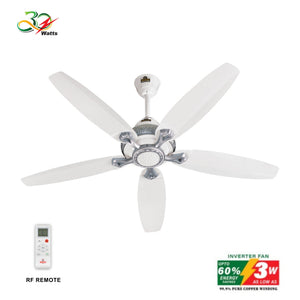
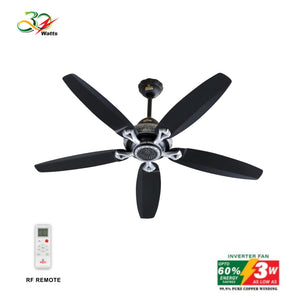
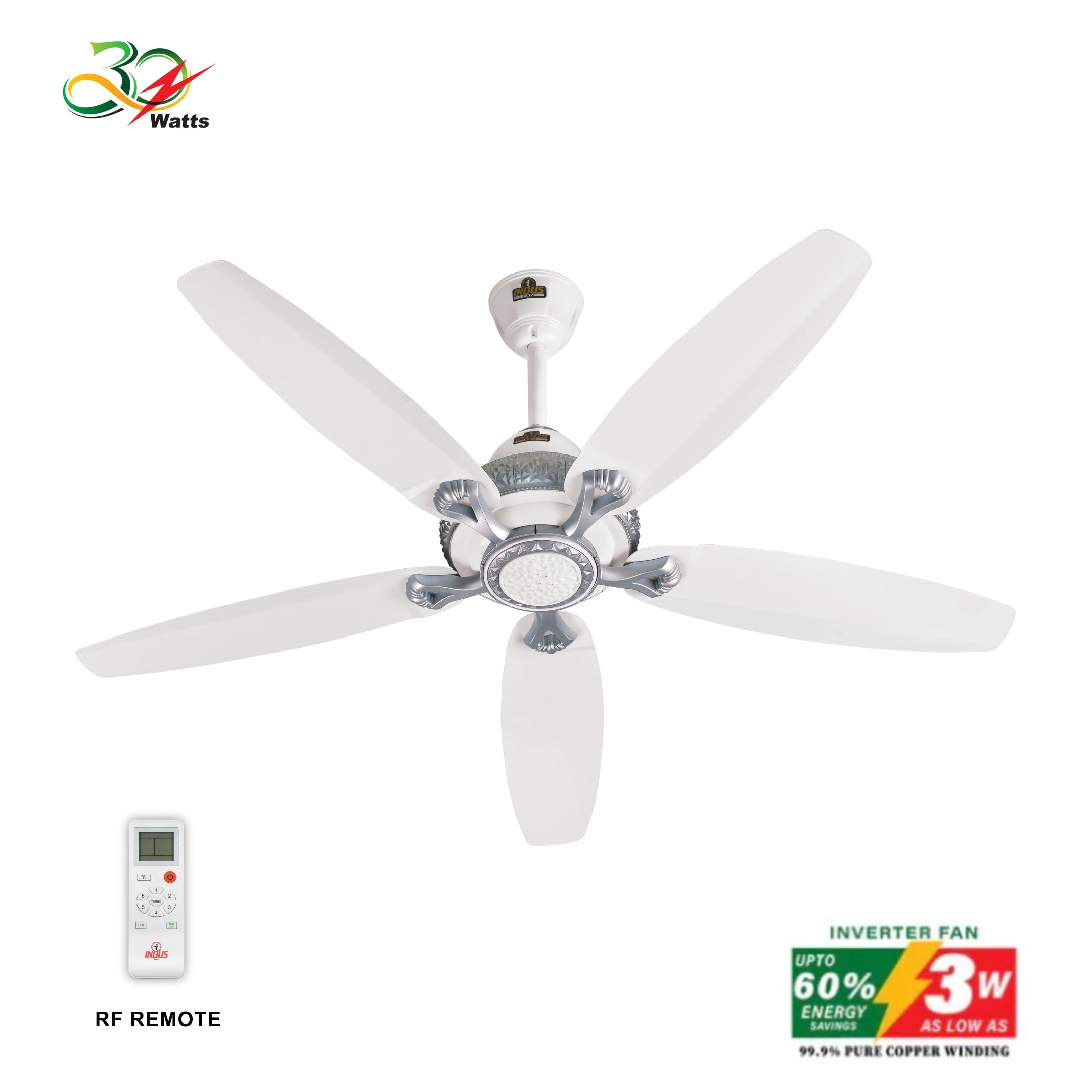
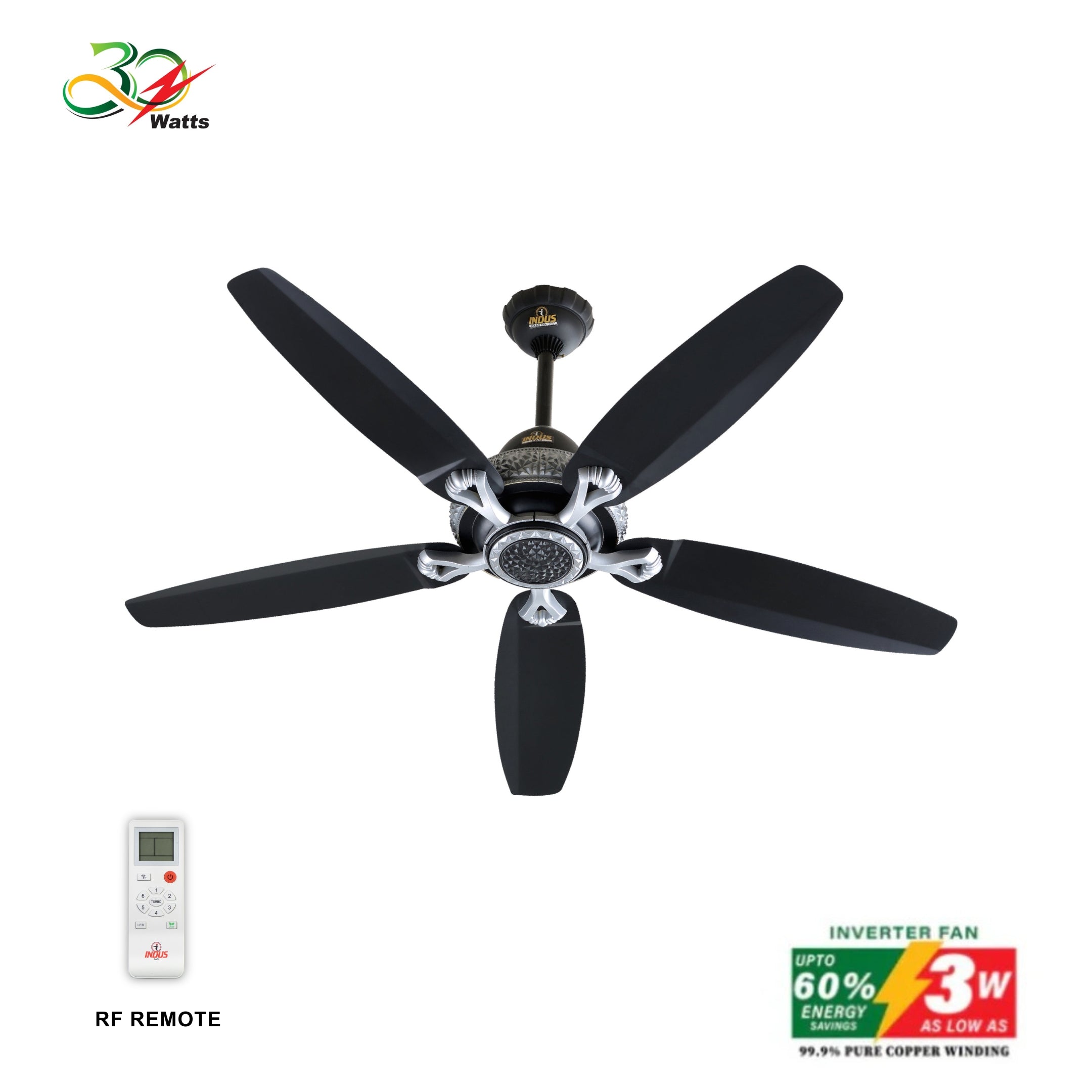
Marvel Diamond Ceiling Fan (30-Watt Inverter Fans)
Compare color
Ask a question
💡 Shipping charges vary by zone. View Zone-wise Shipping Charges
Guarantee Safe Checkout
Description
| Specification | Value |
|---|---|
| Product Name | 30 Watt Inverter Fan |
| Operating Voltage | 120–240 Volt |
| Operating Frequency | 50 Hz |
| Power Consumption | 30 Watt |
| Service Value | 8.24 m³/min/watt |
| Air Delivery | 249.6 m³/min |
| Rating | — |
| R.P.M (Revolutions/Min) | 310 |
| Body Gross Weight | 9.400 kg |
| Body Net Weight | 5.650 kg |
| Blade Gross Weight | 1.449 kg |
| Blade Net Weight | 1.370 kg |
30 Watt Inverter Fan: 7 Smart Benefits for Pakistan
Choosing a ceiling fan in Pakistan isn't only about airflow or design. Power consumption has become an important part of the buying decision, particularly for homes and offices that use UPS, solar systems, or generators during power interruptions. A 30 watt inverter fan is designed around this requirement, using a BLDC inverter motor that draws 30 watts of power.
Indus Home Appliances offers a dedicated range of 30 Watt Inverter Ceiling Fans with 17 models. The range uses BLDC inverter motor technology, 99.99% pure copper winding, and ball bearings. The fans are also compatible with UPS, solar, and generator power.
For buyers comparing energy-efficient ceiling fans in Pakistan, understanding the difference between a 30W fan and a conventional 75-120W fan can make the purchasing decision much clearer.
What Is a 30 Watt Inverter Fan?
A 30 watt inverter fan is a ceiling fan designed to operate with a power draw of 30 watts while using inverter-based BLDC motor technology. In comparison, standard fans commonly consume around 75-120 watts.
The lower power requirement makes this type of fan particularly relevant for households looking to reduce electricity consumption or operate fans through backup power systems.
The term "inverter" refers to the motor and electronic control technology used to operate the fan efficiently. Instead of relying on the conventional motor design found in many standard fans, BLDC technology is used in the Indus range.
How BLDC Inverter Technology Works.
BLDC stands for Brushless Direct Current. A BLDC motor doesn't use traditional brushes for motor operation. Instead, electronic control is used to manage the motor's operation.
For a ceiling fan, this technology is useful because the motor is designed around controlled electrical operation and lower power consumption.
Indus uses BLDC inverter motors across its 30 Watt Inverter Ceiling Fan range. This is one of the key differences between these models and conventional ceiling fans.
Why 30 Watts Matters
The most straightforward benefit is the stated power requirement.
Indus 30 Watt Inverter Ceiling Fans are rated at 30 watts, while standard fans generally consume around 75-120 watts. Based on those figures, a 30W model uses substantially less electrical power during operation.
For homes with several fans running for extended periods, power consumption becomes an important part of monthly electricity usage.
It's also relevant when a fan needs to operate through a UPS, solar system, or generator because lower-wattage appliances place a smaller electrical load on the available backup system.
Why Choose a 30 Watt Inverter Fan in Pakistan?
Pakistan's electricity requirements can vary considerably between homes, offices, shops, and other spaces. During periods when backup electricity is needed, the power rating of everyday appliances becomes especially important.
A 30W ceiling fan addresses this consideration directly by combining low power consumption with BLDC inverter technology.
Lower Power Consumption
The Indus range consumes 30 watts, compared with approximately 75-120 watts for standard fans.
The difference is significant enough to make wattage worth considering when purchasing fans for multiple rooms. If a household operates several ceiling fans at the same time, choosing lower-wattage models can reduce the overall electrical load.
The supplied product specifications describe this difference as approximately 70% savings compared with standard fan consumption.
However, actual household electricity savings will depend on operating hours, electricity tariffs, the number of fans being used, and other appliances running at the same time.
UPS, Solar, and Generator Compatibility
Indus 30 Watt Inverter Ceiling Fans are compatible with UPS, solar, and generator power.
This makes them relevant for homes and workplaces where backup electricity is part of normal daily use. A lower-wattage fan can also be easier to consider when planning the electrical load of a backup setup.
Rather than looking at fan price alone, buyers should consider where and how the fan will be powered.
For example, someone purchasing a fan specifically for a room that frequently operates on UPS power should consider both the fan's wattage and the capacity of the overall backup system.
99.99% Pure Copper Winding
The motor winding used in Indus 30 Watt Inverter Ceiling Fans is specified as 99.99% pure copper.
Copper is used in electrical motor windings because it conducts electricity effectively. In the context of these fans, the 99.99% pure copper winding is one of the stated construction features of the BLDC inverter motor.
When comparing different fan models, buyers should look beyond appearance and consider motor construction as part of the specification sheet.
Ball Bearing Motor Design
The Indus 30 Watt Inverter Ceiling Fan range also uses ball bearings.
Bearings are an important mechanical component in rotating equipment because they support movement between components. For buyers, the presence of ball bearings is therefore another useful specification to consider when comparing motor designs.
Together, the BLDC inverter motor, 99.99% pure copper winding, and ball bearing construction form the core motor specifications provided for this range.
30 Watt vs Standard Fan: Power Comparison
The easiest way to understand the difference is to compare the stated power requirements.
|
Feature |
Indus 30W Inverter Ceiling Fan |
Standard Fan |
|
Power consumption |
30 watts |
75-120 watts |
|
Motor technology |
BLDC inverter motor |
Standard motor |
|
Copper winding |
99.99% pure copper |
Varies by model |
|
Ball bearing |
Yes |
Varies by model |
|
UPS compatibility |
Yes |
Depends on model |
|
Solar compatibility |
Yes |
Depends on model |
|
Generator compatibility |
Yes |
Depends on model |
|
Stated saving |
Approximately 70% |
— |
The table shows why wattage is an important specification when selecting a ceiling fan. A 30W model has a substantially lower stated power requirement than a fan operating in the 75-120W range.
Understanding the Difference in Wattage
Wattage indicates the rate at which electrical power is consumed while the appliance is operating. It doesn't, by itself, tell you everything about airflow, room suitability, or the overall quality of a fan.
That's why buyers shouldn't make their decision on wattage alone.
A good comparison should consider the motor technology, stated airflow, electrical compatibility, construction, model specifications, and price.
Indus 30 Watt Inverter Ceiling Fans
Indus Home Appliances offers 17 models in its 30 Watt Inverter Ceiling Fan range.
Having multiple models allows buyers to compare designs and specifications instead of being limited to a single ceiling-fan option.
The range is positioned around three key requirements: lower power consumption, inverter-based motor technology, and compatibility with common backup power sources used in Pakistan.
You can explore the available products directly through the official Indus Home Appliances website.
17 Models for Different Preferences
The 17-model range means buyers can compare available designs and select a model according to their preferred appearance and stated specifications.
This is particularly useful for customers furnishing multiple rooms. A buyer may want the same underlying 30W technology while choosing different models according to the look of a bedroom, living room, office, or other space.
The important point is to compare the individual product specification rather than assuming that every model has identical airflow or dimensions.
Marvel Model Specifications
The Marvel model provides a specific example from the range.
Its supplied specifications include:
- Air delivery: 249.6 m³/min
- Speed: 310 RPM
- Voltage: 120-240V AC
These figures provide a more concrete way to evaluate a fan than generic statements about performance.
Air delivery is especially useful when comparing models because it gives the buyer a measurable airflow figure. RPM, meanwhile, indicates the rotational speed of the fan.
The Marvel model's specifications should be considered independently from other models because the supplied airflow and speed figures are specifically provided for Marvel.
30 Watt Inverter Fan Price in Pakistan
The price of Indus 30W ceiling fans varies across the range. The supplied price range is Rs. 11,640 - Rs. 25,740.
This means buyers can compare multiple models within different budget levels rather than expecting one fixed price for the entire range.
Price is only one part of the buying decision. A lower-priced model may be suitable for one buyer, while another customer may prioritize a particular design or model specification.
What Affects Fan Pricing?
Within a multi-model product line, prices can vary because different models may have different designs, configurations, or product positioning.
For Indus, the supplied price range covers the 17-model 30 Watt Inverter Ceiling Fan line.
When checking the current price, buyers should refer to the individual product listing because product prices can change over time.
How to Choose Within Your Budget
If your budget is limited, start by identifying the specifications that matter most.
For example, if low electricity consumption is your priority, the 30-watt rating is central to the comparison.
If airflow is important, check the specific air-delivery figure listed for the model. If backup-power compatibility matters, confirm that the model supports UPS, solar, and generator power.
This approach is more useful than selecting a fan based solely on appearance or price.
Is a 30 Watt Fan Suitable for Your Home?
A 30W ceiling fan can be considered for bedrooms, living spaces, offices, and other areas where ceiling-fan airflow is required, but suitability depends on the individual room and the specifications of the selected model.
The most important point is that not every 30W model should automatically be treated as identical.
Bedrooms
Bedrooms are commonly used for long periods, particularly at night. Because the fan's stated power draw is 30 watts, buyers who want lower electricity consumption may consider this type of fan for bedroom use.
However, room size, ceiling height, airflow requirements, and personal comfort should also be considered.
Living Rooms
Living rooms may require more attention to airflow because they can be larger or occupied by more people.
If you're selecting a fan for a living room, check the specific model's air-delivery specification instead of relying only on its wattage.
For example, the Marvel model has a stated air delivery of 249.6 m³/min.
Offices and Workspaces
A ceiling fan can also be useful in offices and workspaces where electricity consumption needs to be considered alongside comfort.
The 30W power rating can be particularly relevant when several fans or other electrical devices operate simultaneously.
For offices using generators or UPS systems, the supplied compatibility with UPS, solar, and generator power provides another reason to consider this product category.
How to Choose the Best 30 Watt Inverter Fan
The phrase "best" depends on the buyer's requirements. Rather than choosing a fan simply because it is marketed as the best, compare measurable specifications and practical requirements.
Check Motor Technology
Start with the motor.
Indus uses a BLDC inverter motor in its 30 Watt Inverter Ceiling Fan range. The range also specifies 99.99% pure copper winding and ball bearing construction.
These are useful specifications to compare when evaluating different inverter ceiling fans.
Check Power Requirements
The stated power consumption is one of the clearest differences between this category and standard fans.
Indus models are rated at 30 watts, compared with approximately 75-120 watts for standard fans.
If reducing electrical load is important to you, this should be one of the first specifications you check.
Check Air Delivery
Low power consumption doesn't eliminate the need to consider airflow.
Air delivery is a useful measurable specification when comparing fans. The Marvel model, for example, has a stated air delivery of 249.6 m³/min.
If airflow is your priority, compare the specific air-delivery figure for each model you're considering.
Check the Available Models
Indus offers 17 models in this range.
Instead of selecting the first available option, compare the models according to design, price, stated specifications, and your intended room.
A multi-model range gives you more flexibility to match the product to your home rather than compromising on appearance or budget.
Indus vs Other Brands
The Pakistani fan market includes several established manufacturers and inverter-fan options. The competitors identified for this product category include GFC Fans, Royal Fans with iTurbo, Tamoor Fans, and Belvin.
The right comparison should focus on verifiable specifications rather than brand claims alone.
Why Energy-Efficient Fans Matter
A ceiling fan may run for several hours every day, so its power rating can have a meaningful effect on electricity usage over time.
A fan rated at 30 watts requires considerably less electrical power than a standard fan rated at 75-120 watts.
This difference can also matter when electricity is supplied through a backup source. UPS systems, solar installations, and generators all have limited power capacity, so appliance wattage is an important consideration when calculating the electrical load of a household or workplace.
The key is to look at the complete electrical setup rather than assuming that any single appliance determines total electricity consumption.
Who Should Consider a 30W Inverter Ceiling Fan?
This category can be relevant for several types of buyers.
Homeowners may consider it when they want lower-power ceiling fans throughout the house.
Solar users may be interested because the Indus range is compatible with solar power.
UPS users can consider the 30W rating when planning the electrical load of backup systems.
Generator users may also benefit from considering lower-wattage appliances as part of their overall load planning.
Office owners can evaluate 30W models when multiple fans operate for extended periods.
The common factor is the 30W power requirement combined with inverter motor technology.
Frequently Asked Questions
Is a 30 watt fan enough for a bedroom?
A 30 watt fan can be suitable for a bedroom, but room size, ceiling height, airflow needs, and the specific model should be considered. Indus 30 Watt Inverter Ceiling Fans use a 30-watt BLDC inverter motor, while the Marvel model has a stated air delivery of 249.6 m³/min.
Does a 30 watt fan run on UPS?
Yes, Indus 30 Watt Inverter Ceiling Fans are compatible with UPS power. The fan's 30-watt power rating makes wattage an important consideration when planning the total UPS load. Actual runtime depends on the complete UPS setup, battery capacity, efficiency, and other connected appliances.
What is the 30 watt inverter fan price in Pakistan?
Indus 30 Watt Inverter Ceiling Fans are priced from Rs. 11,640 to Rs. 25,740 across the supplied 17-model range. The exact price depends on the selected model, so buyers should check the individual product listing for the current price.
How much electricity does a 30 watt fan consume?
A 30 watt fan has a stated power draw of 30 watts while operating. For comparison, standard fans generally consume around 75-120 watts. The Indus product range states approximately 70% savings compared with standard fan consumption, although actual household savings depend on usage.
Is a 30W fan compatible with solar power?
Yes, Indus 30 Watt Inverter Ceiling Fans are compatible with solar power as well as UPS and generator power. The 30-watt rating is useful when planning the electrical load of a solar or backup-power system, although complete system performance depends on the entire installation.
Which is the best 30 watt inverter fan?
The best 30W inverter fan depends on the buyer's requirements, including airflow, design, price, and electrical setup. Indus offers 17 models, while the Marvel model is specified at 249.6 m³/min air delivery, 310 RPM, and 120-240V AC.
How is a 30W inverter fan different from a standard fan?
The main difference is power consumption and motor technology. An Indus 30W inverter ceiling fan uses a 30-watt BLDC inverter motor, while standard fans typically consume 75-120 watts. Indus models also specify 99.99% pure copper winding and ball bearing construction.
Final Takeaway
A 30W inverter ceiling fan combines a 30-watt power rating, BLDC inverter motor, 99.99% pure copper winding, and ball bearing construction, with compatibility for UPS, solar, and generator power. Indus offers 17 models priced from Rs. 11,640 to Rs. 25,740, giving Pakistani buyers multiple options based on budget, design, and model specifications.
Additional Information
| Color |
White Silver, Black Silver |
|---|


